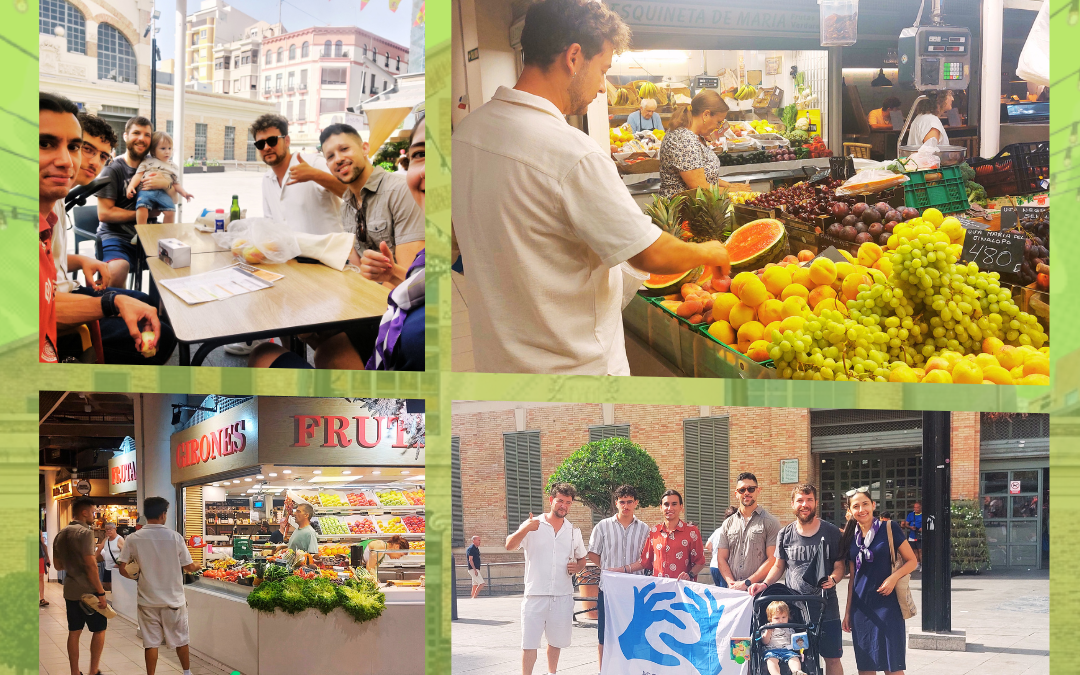
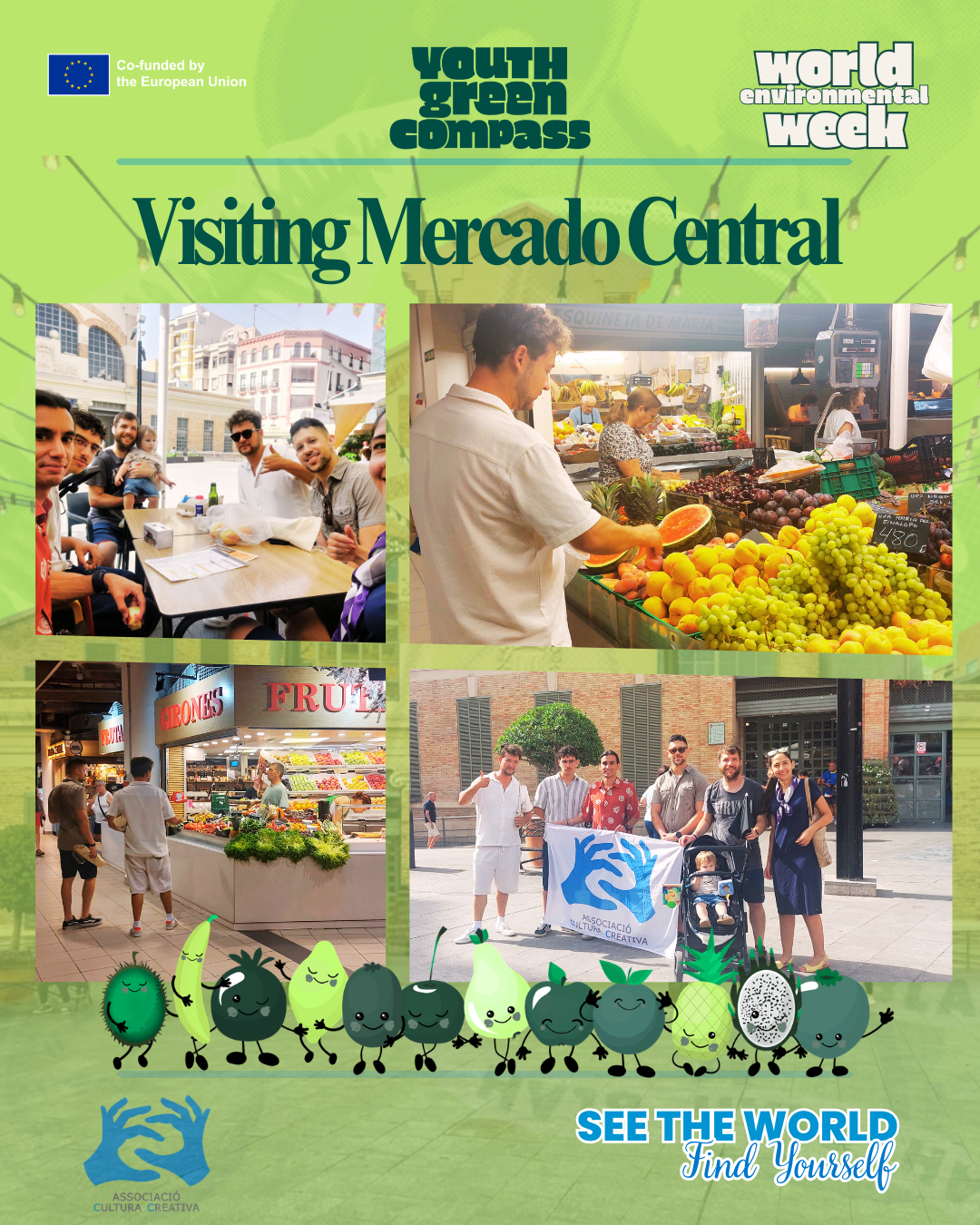
On 11 July, Cultura Creativa organised a guided tour of Alicante’s Central Market and the Plaza de las Flores as part of World Environmental Week, one of the initiatives of the Youth Green Compass project. Four young people from Alicante took part in the activity, keen to discover one of their city’s most iconic landmarks from a sustainable perspective.
The main aim of the visit was to raise participants’ awareness of sustainable and responsible consumption, with a focus on local, seasonal and zero-kilometre produce. The activity also sought to highlight the environmental impact of our everyday purchasing decisions and to introduce young people to the Youth Green Compass project and its tools through a real-life, accessible setting.
The tour began with an overview of the history of the Central Market. Built in 1911, it was the scene of one of the most tragic events in the city’s history: the bombing of 25 May 1938, at the height of the Civil War, which claimed more than 300 civilian lives. Today, the square situated next to the rear façade of the building is named Plaza 25 de Mayo in its memory, although many residents of Alicante know it as Plaza de las Flores because of the flower stalls that fill it with fragrance and colour.
Kilometre Zero and seasonal produce
The group then walked around the market stalls, focusing on sustainable consumption. During the walk, they discussed the importance of buying local produce and what the concept of ‘zero kilometre’ really means: food produced close to where it is consumed, which requires less transport and directly supports local producers.
Participants also learnt how to identify seasonal fruit and vegetables and to understand why choosing them is a more environmentally friendly option. This is because seasonal produce generally requires fewer resources to grow, transport and preserve, and reaches our tables at the peak of its flavour and freshness.
As a practical part of the activity, the group looked for seasonal produce amongst the stalls and chose some fruit to buy, which they then shared amongst themselves. A simple gesture that helped to link the discussion on sustainable consumption to an everyday purchasing decision.
A Green Point in the Youth Green Compass
During the visit, the Youth Green Compass project was also presented, along with its main objectives and some of its tools. These include the Green Points (areas of the city that the project highlights for their connection to sustainability) and the City Compass app, where this information can be accessed, as well as on the Youth Green Compass website.
The Central Market was not chosen at random: it is one of the project’s Green Points and can be found on the City Compass app. Its inclusion reflects precisely what was discussed during the visit, as it is a neighbourhood market offering fresh, local produce and a wide network of small shops that form part of the city’s daily life.
Exploring the area in person enabled the participants to link the project’s tools to a real, local place. It also encouraged them to use City Compass to discover other sustainable spaces in Alicante and incorporate them into their daily lives.
Rediscovering our own city
The visit concluded with a joint discussion on how small changes to our shopping habits can contribute to a more sustainable lifestyle. Choosing local and seasonal produce or supporting small businesses are simple decisions which, when taken together, have a real impact on the planet.
One of the most rewarding aspects of the event was realising that there is always something new to discover, even in places we consider our own. The participants, all young people from Alicante, learnt stories about the Central Market that they hadn’t known before, and some admitted that they hadn’t visited it for years.
At the end of the day, the group pledged to make more conscious purchasing decisions: to support local producers, choose seasonal produce and opt for small businesses wherever possible. Activities such as this reflect the spirit of Youth Green Compass, which aims to bring sustainability into young people’s everyday lives, starting with their own local environment.
Youth Green Compass is a project co-funded by the European Union. Views and opinions expressed are however those of the author(s) only and do not necessarily reflect those of the European Union or EACEA. Neither the European Union nor the granting authority can be held responsible for them.

Comentarios recientes